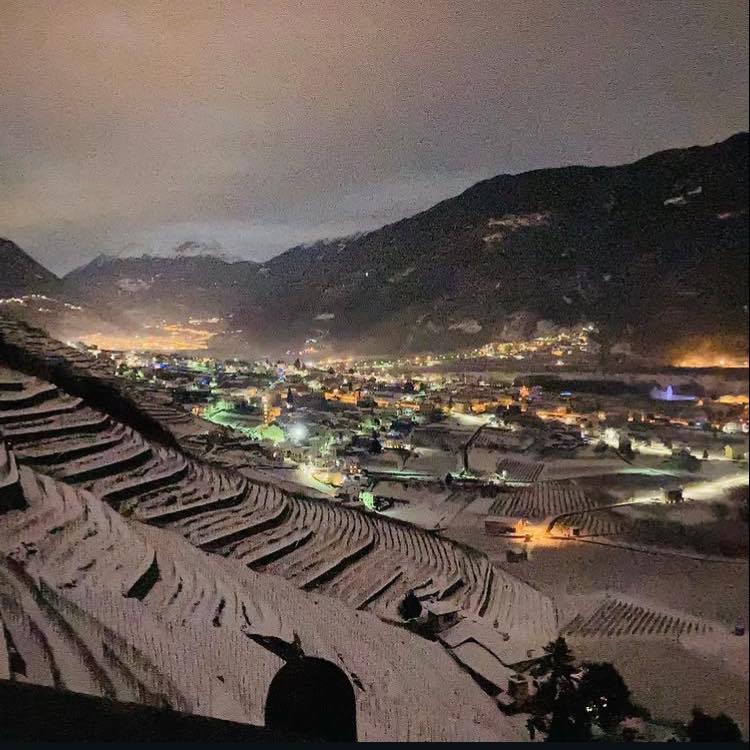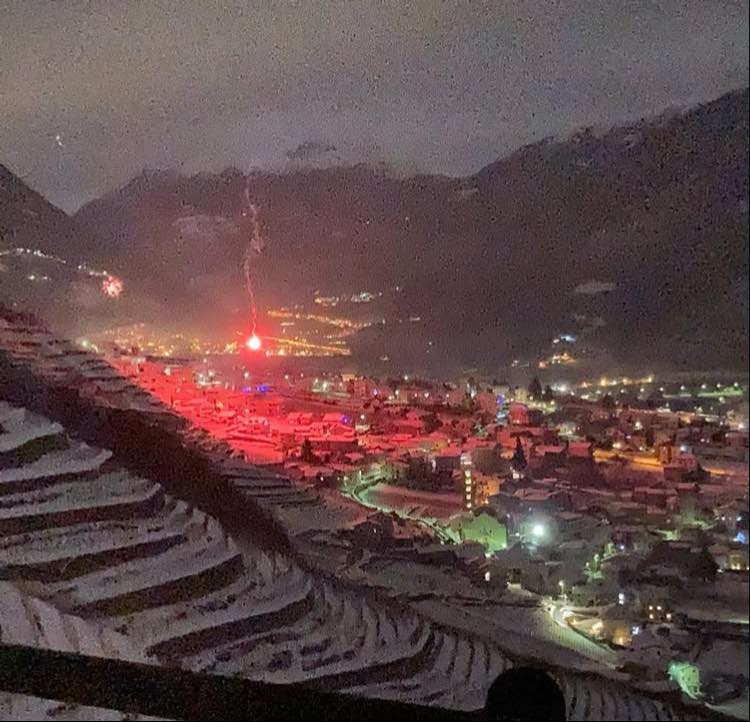

It's New Year's Eve. We greet 2025 with photos taken on 31 December 2020 when the greatest wish for the new year was to make the covid disappear.
But have you ever wondered what people did in our countries 100 years ago?
Here is a testimony written by Vanda Cerveri:
BIANZONE, 1950s: New Year's Eve in the barn
Flash back of a life lived: “Gh'è temp, gh'è temp..” (there is time, there is time..)
“Stasira am specia l'an noef, sa fa festa e sa va a lec’ tardi” (Tonight we wait for the new year, we party and we go to bed late) is the phrase I hear repeated already in the morning.
I also really like the idea because in my house we usually go to bed almost immediately after eating soup and the word 'feast' is only uttered when talking about Sundays or other days when there is mass.
The day is longer than usual because I can't wait for dark. And darkness finally arrives. We all have dinner together and, strangely, my mum doesn't insist as usual that I eat more. My brothers are already grown up and go off on their own. They say they will go around the country with partners (friends) to stop the old year.
Preparations are made.
In the scoss (which is the apron without a bib, tied at the waist and held up by the flaps), the mother puts a few apples, some pears, a few walnuts, a few bunches of white grapes with small berries that are good, she says, if you eat them on New Year's Eve, and some brasciadeli (dry bread doughnuts).
I bring my nice little magazine, the gift that the Baby Jesus brought me because my teacher called Lidia told him I did well at school.
The father goes to the cellar to fill al lìtru (a pot-bellied, white and blue earthenware jug) with good wine, the older one that, as he often says, al fa resuscità anca i mòort, kept in a separate cask. He also takes some luganeghi (dried sausages) and a piece of cheese from the old one.
Then, with a large woollen shawl over our shoulders and holding each other tightly, we go together, almost in a hurry because of the bitter cold, to our stable, a rustic room without windows, long and narrow with walls blackened by the years, where there is always a nice warmth due to the presence of the cows and other animals.
One enters trying to quickly close the door to keep out the cold and then sits on top of a pile of straw. The air is very humid and stale. Even though it's impregnated with the typical smell of manure, it doesn't bother me because, as Mum says, it's completely natural.
At the back of the barn are the two cows tied to the manger. They are already lying down and ruminating continuously. They seem to be eating fag. When they turn towards us, they stop chewing for a moment and remain motionless. But as soon as their dad turns to them, calling them by name: “Hey, Bionda tranquila, l'è tut a post...”. “Bucc, che ma cùntat? Éh?”, they calm down and resume moving their mouths with the usual rhythm.
The little calf, a little further on, can't keep still, gets up, lies down, and then gets up again, looks at me and seems to want to communicate something to me. I then approach him, tell him to be quiet, stroke him a little and he slowly goes back to lying down.
In one corner is the très (small plank fence) with the ciùn (pig) that I can never get a good look at except when I let my dad lift me up to look down. What I like most about my ciùn is its curly tail. Even if I can't see him, every now and then I hear him, grunf ... grunf ... approaching the truogolo to noisily sip some of his colubbia (slop), spraying it all over the place, even over the slats.
Above the mugèl de la gràsa (pile of day-old manure) the hens perch, motionless, on horizontal poles fixed to the wall. Every now and then, however, one or the other loses its balance, bumping into the nearest one and creating general mayhem. I am amused by their acrobatics to regain their places and sadistically stand there waiting to watch them fall en masse onto the manure, but each time I am disappointed because, almost as if by magic, after so much turmoil and uproar, everything comes together again.
I leaf through the Corrierino dei piccoli, although the dim light of the too-dirty bulb does not allow me to read much. Mum, as always, makes socks and dad fixes the "stropi" (shoulder straps) of the basket, he always finds something to do even in the stable.
“Ueih, ga siif? Am sa scià!” (Are you there? We are there!)
The door opens ajar and the father: “Vignin a la quick! Serì fo subit que li vachi i ciapa frec’ e dopu adiu lac’!” (Enter quickly. Close quickly otherwise the cows will catch cold and afterwards goodbye milk!)
They are the neighbours: the Rosa Ciapèta, at Lurenzin, the Delina Peciàta, the Mighina Peregascia, at Gim. They sit with us on the straw. They too have brought something to eat. La Rosa lays a wrapper on an del scagn de mulsc (milking stool) that intrigues me.
He removes the mantìn (napkin) and some beautiful loaves of bread with figs and walnuts appear, fresh from the oven, or better still warm from the oven, which really makes my mouth water! I reach out my hand to take a piece. “Gh'è temp, gh'è temp .. (There's time, there's time)” they all say to me in chorus. And the Rose covers all that goodness. To take my mind off it, I immerse myself in the pictures in my comic book and talk a little with the comic characters.
At a certain point the tones of voices become heated.
They talk about the Bratta road they are building and the problems there have been because of the route. My dad often repeats that he is among those who have had to lose the most ground.
“Bloody hell, I've passed with two bends on my side, and I've been left with a good bit of field and then, if you'd gone to Sundri to complain, there would have been three bends!’
(For crying out loud, they passed with two bends on my property and took away a big chunk of my field and then, if I didn't go to Sondrio to complain, there were three bends)
“However, with the road no(v)a,” he adds immediately afterwards, "adès an pol purtà a cà al fee e li tartifuli multu mèi di prima, perché li vachi li fa(v)a trop fadiga a tira su al car da li Guarnèli.”
(But with the new road, you can now bring home the hay and potatoes much better than before, because the cows had too much trouble pulling the cart up from Via Guarnelle)
I immediately put the magazine aside and settle down well in the straw. I like to hear the grown-ups talking. The evening gets livelier and livelier with the discussions of the men, who between breaks have a drink of wine, passing the lìtru from one to the other. Yes, they are always the ones holding court.
The women barely manage to get into their conversations and, as soon as they mention something, they are immediately silenced because “quisti i’ è robi de um e miga de femni” (these are things for men, not women). So they chat a little among themselves.
I, however, only listen to men.
I enjoy watching them argue because they get angry, make funny faces, gesticulate, move, stand up and sit down all the time ...
The past few years of war is always the most talked about topic.
A glance at the speakers and one at the buscèi cui fich... I try not to miss a single word. Their speeches become more and more detailed, they become imaginative, and I, with my imagination, slowly become the protagonist in their stories ...
And so I run away with the partisans into the mountains, I climb with the Jews towards the pass, I stumble, I fall, I get back up.... I run with the fascists pursued by the partisans ... I hear the Germans firing, I see the plane bombing the station of Bianzone, I hear the moans of the teacher shot dead ... I am there with her, I scream, I try to escape, but someone holds me back and I can't, I can't even shout anymore ... I hear my name repeated ...
I open my eyes and ... and thank goodness!!! I see my mother wishing me a Happy New Year and telling me to get up because we have to go to “mass first”. I look around and realise with relief that I am in my bed.
“But... ‘l buscèl?..the new year... the party??”
“Last night you fell asleep in the stable, ta sé propi la durmentuna! On the table down in the kitchen there's a nice buscelin all for you. The party? When it's peaceful and healthy and you're well together, it's always a party!”
Mum opens the doors. It is snowing outside and I am happy.
A NOTEBOOK OF THE TIME READS:
“[...] on the last evening of the year, in Bianzone, it was customary to put woods, stones, pins, wire, carts, trestles, bundles of wood and other things across the streets. This was done in an attempt to stop the year that was leaving.
Some good-for-nothings, always on the last evening of the year, would go into some stable, detach one beast and lead it to another far away from there. Thus the two stable masters would find one with one more beast and the other with one less.
The beast coming out of the stable symbolises the old year departing and the beast entering, the new year arriving”.
Happy 2026 from the members of the Ecomuseo of the Rhaetian Terraces in Bianzone